
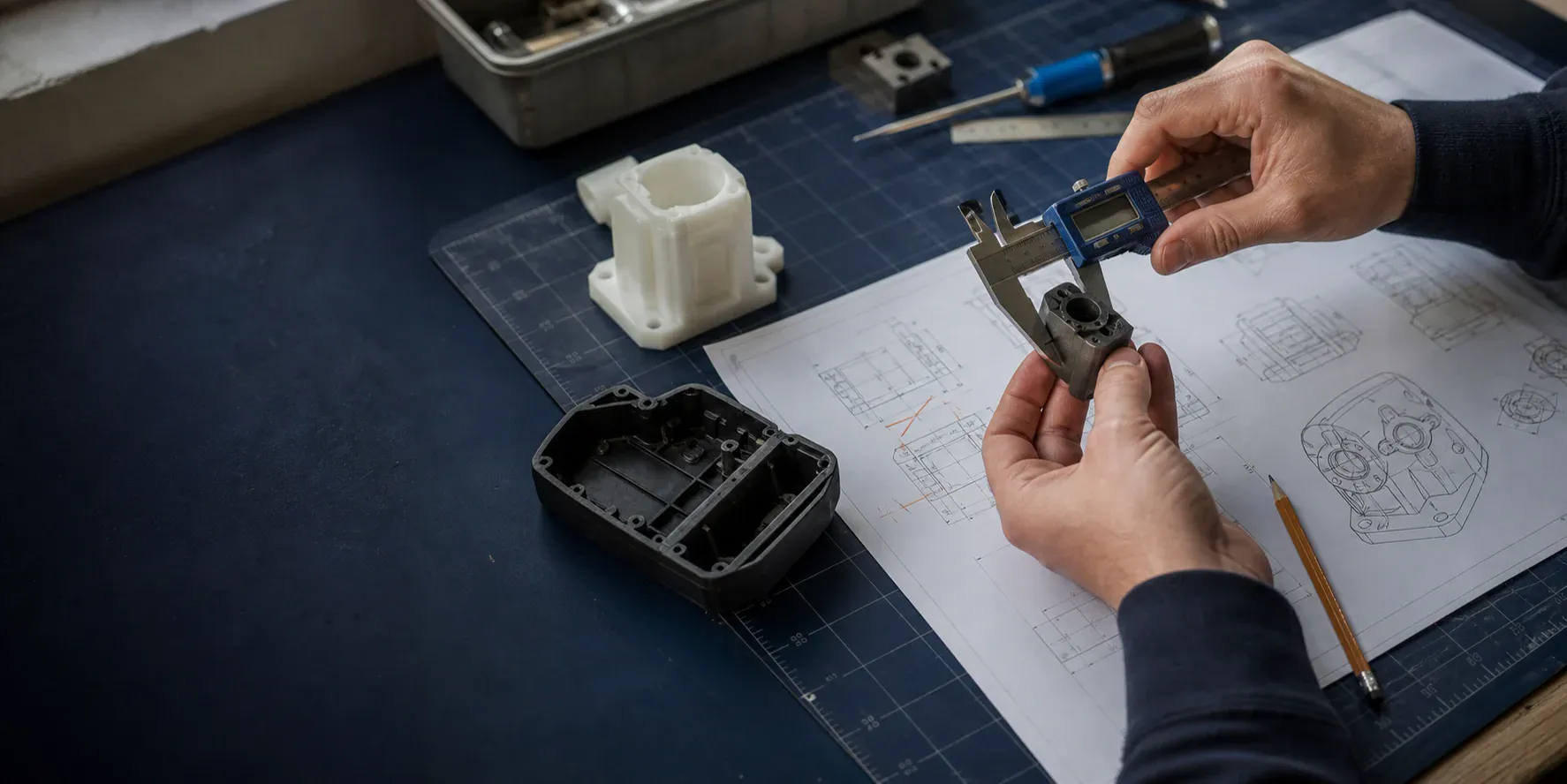
Most teams delay the first email because they think the drawing has to be perfect. It does not. The useful first step is sending enough context for an engineer to see the constraints — not a polished sales deck.
The minimum that usually works
Any one of these is a reasonable start:
- A CAD file — STEP, IGES, or native format if you have it
- A PDF drawing with dimensions on the critical features
- A physical sample — even a broken prototype tells us what failed
- Clear photos with a ruler or known object for scale, plus a short note on what the part must do
A paragraph in plain language often matters more than a missing tolerance block: load, environment, expected volume, and what went wrong with the last supplier.
What speeds up the review
| You send | Why it helps |
|---|---|
| Target quantity (even a range) | Separates prototype routes from tooling routes |
| Material preference, if any | Or "open to recommendation" — both are fine |
| Where the part lives | Temperature, moisture, UV, chemicals, user contact |
| What must mate or align | Multi-part products fail at interfaces, not in isolation |
| Your deadline | Lets us say early if the schedule is realistic |
You do not need a BOM, a brand story, or a finalized color palette for the first technical read.
What we do with it
An engineer reviews what you sent against our own CNC and mold floor and the specialist workshops we manage. You get back:
- Whether the part is realistic in the material and process you had in mind
- What would change in a DFM pass before tooling money moves
- Whether the next step is prototype, sample, or tooling — and what that costs in time, not just price
Design fee quotes, when they apply, credit fully toward production. Tooling belongs to whoever pays for it. One engineer stays on the project through shipment.
Before sensitive files
If the drawing is not public yet, say so in the first message. We review NDAs before you upload restricted data — that is normal, not a delay tactic.
When we are not the right fit
We will say so early: wrong process, wrong scale, certification you require that we do not hold, or a geometry we cannot stand behind in production. That saves you weeks compared to a factory that says yes and disappears.
If you have a sample or drawing sitting in a folder, start a project — a useful answer usually comes back within one business day.
Related reads
CNC vs Injection Molding: Which Fits Your Part
The two most common processes for custom parts are not interchangeable. Here's how to decide which one fits your project.
guideDesigning for Manufacturing: 5 Decisions Upfront
Material selection comes last, not first. Decide function, environment, volume, tolerance, and budget before asking what a part should be made of.
guideMulti-Material Products: One Partner or Three?
Plastic, metal, and glass in one product often means three vendors and three failure points. One team can own the spec instead of the email chain.
guideTooling Ownership: What to Lock In Before You Pay
Injection molds outlive any production run. Decide who pays, who owns, and who can move the tool before the first tooling invoice — in writing.
materialWhy POM Fits Quiet, Wear-Resistant Gears
POM is not the only gear material, but its friction, stability, and wear behavior often make it a strong starting point for precision plastic gears.
Next step
Turning an idea into a shipped product?
Send a drawing, sketch, or sample. A real engineer reviews it — usually within a business day, no commitment.