
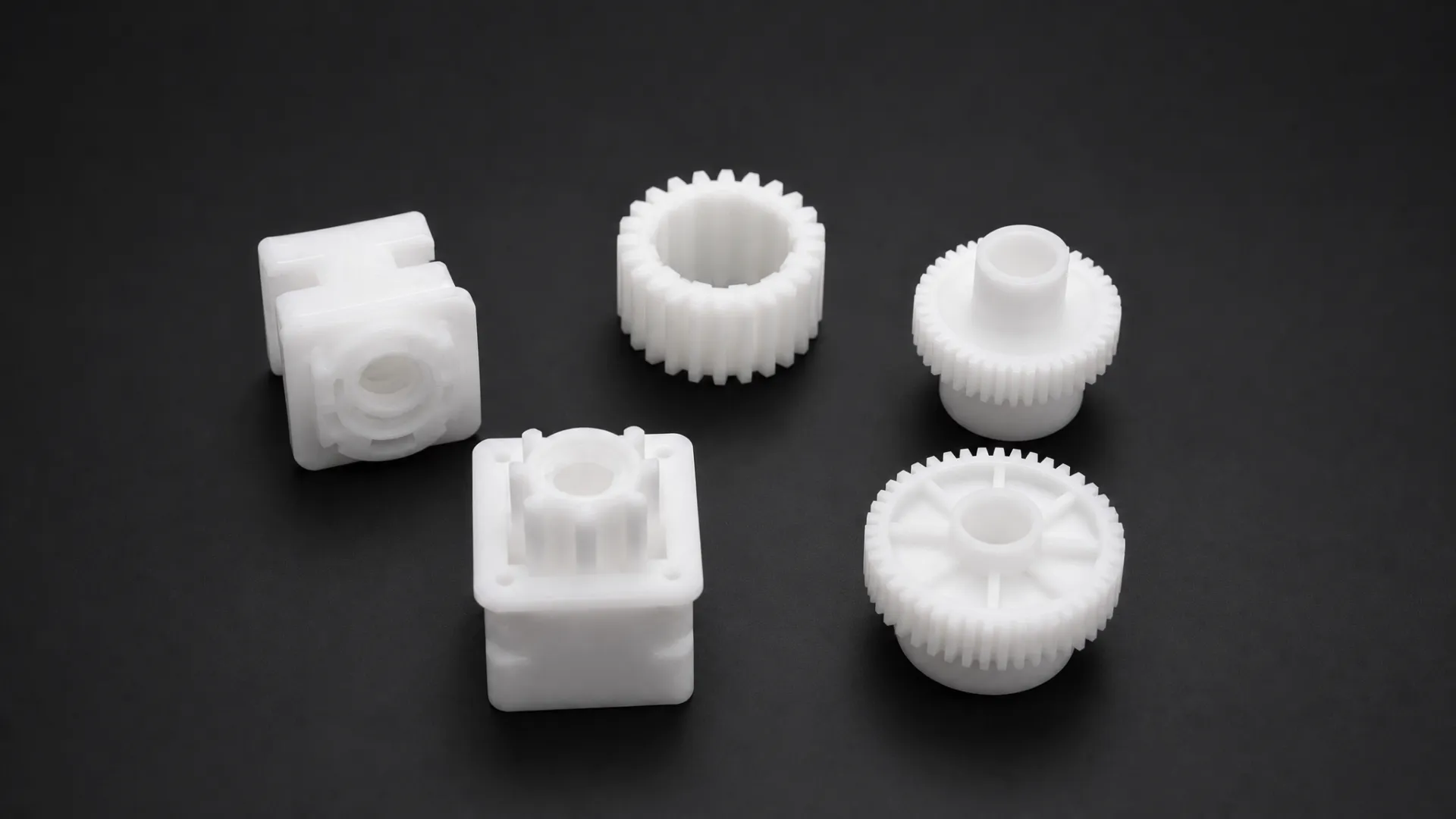
When you're designing a gear assembly — especially one where multiple gears mate together and need to run quietly over a long service life — the material choice is critical. Get it wrong and you get noise, premature wear, dimensional drift, or all three. Before settling on a material, it helps to decide the function, environment, volume, tolerance, and budget first.
POM (polyoxymethylene, also known as acetal or Delrin) is one of the most commonly specified materials for precision plastic gears. Here's why.
Low friction without lubrication
The material has relatively low friction compared with many general-purpose plastics. In a well-designed gear mesh, that can support smoother motion and lower wear. Whether lubrication is still needed depends on load, speed, temperature, mating material, and service-life targets.
Dimensional stability
Gears need to hold their geometry. If a tooth deforms even slightly under load, the mesh gets sloppy, noise increases, and wear accelerates.
Acetal generally absorbs less moisture than many nylon grades, which can make its dimensions easier to control in changing humidity. A molded gear still needs correct material conditioning, tool design, shrinkage allowance, and process control.
Wear resistance
In gear-on-gear applications, the material takes a beating. Acetal is often chosen over general-purpose plastics because its wear behavior suits sliding and gear contact. The actual life advantage must be tested in the real assembly; load, tooth geometry, speed, lubrication, and the mating gear can change the result.
Quiet operation
This is where the material can help in products used near people. A well-designed acetal gear mesh can run quietly compared with harder material pairings. In robotic arms, height-adjustable desks, and medical beds, that quietness is a functional requirement, not just a nice-to-have.
When acetal is NOT the right choice
It isn't universal. Acetal is not great for:
- Temperatures beyond the selected grade's continuous-use range. Higher-temperature polymers or metal may be a better fit.
- Extreme impact loads. Polycarbonate or nylon might absorb shock better.
- UV exposure without stabilizers. Untreated acetal degrades in sunlight.
A real example
We've produced POM gears across multiple specs for use in robotic arms, robots, height-adjustable desks, and automatic medical beds. The combination of complex geometry (multiple tooth profiles in one mold), multi-gear mating precision, and the requirement for silent, wear-resistant operation is exactly what the material is built for.
The takeaway: when an application needs precise mating, quiet operation, and controlled wear, acetal is worth evaluating early — then validating in the real load case before production.
Related reads
CNC vs Injection Molding: Which Fits Your Part
The two most common processes for custom parts are not interchangeable. Here's how to decide which one fits your project.
guideDesigning for Manufacturing: 5 Decisions Upfront
Material selection comes last, not first. Decide function, environment, volume, tolerance, and budget before asking what a part should be made of.
guideMulti-Material Products: One Partner or Three?
Plastic, metal, and glass in one product often means three vendors and three failure points. One team can own the spec instead of the email chain.
guideTooling Ownership: What to Lock In Before You Pay
Injection molds outlive any production run. Decide who pays, who owns, and who can move the tool before the first tooling invoice — in writing.
guideWhat to Send When You Start a Manufacturing Project
A sample, CAD file, or clear photos are usually enough for a useful first review. Here is what helps an engineer answer faster — and what you do not need yet.
Next step
Turning an idea into a shipped product?
Send a drawing, sketch, or sample. A real engineer reviews it — usually within a business day, no commitment.